Freitag, 23. Mai 2014

Arnold Dreyblatt - T-Mail

T-Mail, 2005
The work is derived from a larger collection of over 4,000 intelligence documents from State Archives in Europe and North America from the inter-war period. The collection contains daily reports and correspondances between 1915 and 1943, forming a vast communication network in which the official traces and observations of the individual are cross-referenced to historical events, international personalities and geographic locations.

In the World-Wide-Web version called "T.Mail", a selection of hundreds of documents are available as navigatable HTML pages using the "Petal" browser developed by the Department of Culturual Studies at the University of Lüneburg. The information is available through multiple categorical menues, through marked text in the document scans, and through a flash geographic time-line display.
Web Address: http://www.leuphana.de/tmail


Arnold Dreyblatt - metaphors for memory

In his installations, performances and media works, Dreyblatt creates complex textual and spatial metaphors for memory which function as a media discourse on recollection and the archive. His installations, public artworks and performances have been exhibited and staged extensively in Europe. "Dreyblatt's project, maintains its edge--and its importance for the rethinking of identity, history, culture, and memory--by refusing to retreat from or transcend [...] public, archival traces." - Jeffrey Wallen, Hampshire College.
Among the second generation of New York minimal composers, Arnold Dreyblatt has developed a unique approach to composition and music performance. He has invented a set of new and original instruments, performance techniques, and a system of tuning. His compositions are based on harmonics, and thus just intonation, played either through a bowing technique he developed for his modified bass, and other modified and conventional instruments which he specially tuned. He originally used a steady pulse provided by the bowing motion on his bass (placing his music in the minimal category), but he eventually added many more instruments and more rhythmic variety.
Quelle: http://en.wikipedia.org/wiki/Arnold_Dreyblatt


http://www.dreyblatt.de/

The Wunderblock, 2000
In 1925, Freud wrote a text that compares the faculty of memory to a child's toy known as a Wunderblock. It consists of a wax slab stretched with cellophane, upon which a text may be inscribed, and just as readily erased by lifting the cellophane layer up and away from the wax slab.

In contrast to Freud's model, in which the pressure of the act of inscription onto the cellophane surface continues in the direction of the underlying layer of wax, in 'The Wunderblock', the original selection and entry of data has been concluded in the past. The movement originates from ROM and is held in RAM, before travelling up towards the surface.


The ReCollection Mechanism
data projection, circular wire screen, sound, 1998 Black room, computer data projection, suspended wire mesh, sound equipment. Size variable.

An automated writing and recitation machine is found in a darkened black space. One enters a three dimensional data architecture where the process of searching, sorting and locating words and the overlapping inter-textual linkages of information are simulated optically by metaphors of transparence and complexity. Projected onto a barely visible cylindrical screen are multiple transparent layers of continually flowing historical data, which appear to be suspended in the center of the space, and which delineate the room contours with textual landscapes.


Preserving endangered sounds

Swedish nerd fights to save dying soundshttp://www.thelocal.se/20140312/swedes-to-save-extinct-sounds

via Trevor Cox - Preserving endangered sounds
"One place to get ideas from would be Peter Cusack’s Favourite sound project. Peter started exploring the public’s response to sound in London about a decade ago. And I interviewed him about this project for Sonic Wonderland / The Sound Book.  His investigative technique is deceptively simple. He just asks, “What is your favorite sound of London, and why?” In London, respondents to Peter’s question often mentioned Big Ben. The Favourite Sound Project has been expanded and run by others, to involve cities from around the world,
including Beijing, Berlin, and Chicago."
http://acousticengineering.wordpress.com/2014/03/17/preserving-endangered-sounds/

---

Jay-Dea Lopez, fieldrecordings and soundscapes
"I listen to the surrounding environment and question: what have we lost, where are we going, how can an understanding of sound help us appreciate what remains?"
http://soundslikenoise.org/


Sebastiane Hegarty: a British artist, writer and lecturer whose recordings have featured on radio and film.
John Grzinich: an American sound and video artist now living in Estonia, he also co-ordinates the MoKS residency program.
Des Coulam: a British ex-pat living in Paris, he documents the many sounds of Parisian streets, arcades and subways.
Vladimir Kryutchev: a Russian reporter and field-recordist who documents the sounds of local village life.
Magnus Bergsson: an Icelandic field-recordist whose recordings focus on the urban and natural spaces of Iceland.
Ian Rawes: a reporter and field-recordist for the London Sound Survey.
http://www.soundsurvey.org.uk/index.php/survey/blog/
David Velez: a Colombian field-recordist whose recent essay “El Coyote” is an immensely insightful and sensitive reflection on why he chooses to record the subjects that he does.
Quelle: http://soundslikenoise.org/, http://soundslikenoise.org/tag/ian-rawes/


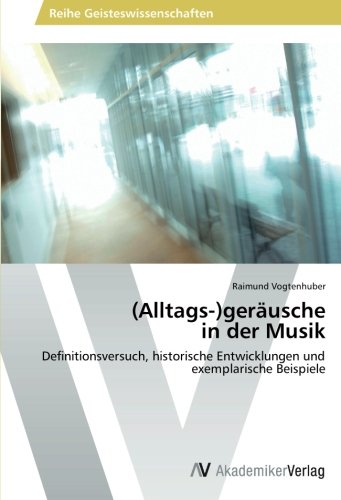
(Alltags-)geräusche in der Musik

(Alltags-)geräusche in der Musik: Definitionsversuch, historische Entwicklungen und exemplarische Beispiele

Es erscheint naheliegend, dass die uns umgebenden Geräusche einen großen Einfluss auf den Menschen und seine Kultur ausüben und schon immer ausgeübt haben. Umgekehrt schafft der Mensch durch seine zivilisatorischen Aktivitäten das typische Klangbild seiner Umwelt. In dieser Arbeit wird das Phänomen des Geräusches, im speziellen des Alltagsgeräusches, und dessen Verwendung und Beziehung zur Musik untersucht. Der erste Abschnitt beschäftigt sich mit den grundlegenden physikalischen Eigenschaften des Schalls und versucht den Begriff des Geräusches im Allgemeinen und des Alltagsgeräusches im Speziellen zu definieren. Es folgen historische Beispiele wie die Geräuschmusik Luigi Russolos, die Musique concréte, das World Soundscape Projekt und Beispiele aus der populären Musik (Beatles) und der Improvisierten Musik (Fred Frith). Zuletzt folgt eine Beschreibung der eigenen Arbeit.

http://www.amazon.de/Alltags-ger%C3%A4usche-Musik-Definitionsversuch-Entwicklungen/dp/3639486412

Akustischer Stadtplan / Soundplan

Akustischer Stadtplan / SoundplanRadiobox, Schulradio, Pädagogische Hochschule Wien, Österreich
http://podcampus.phwien.ac.at/radiobox/archive/831

The Largest Vocabulary in Hip Hop

Matt Daniels is a designer, coder, and data scientist living in New York City. His past works include the Etymology of "Shorty" and Outkast, in graphs and charts. He decided to examine the vocabulary of hip hop artists, and this is what he found. – May 2014

http://rappers.mdaniels.com.s3-website-us-east-1.amazonaws.com/


-------
The Etymology of Shorty in Hip hop
An absurdly nerdy look at how hip hop invented the most important slang of our time.
http://www.mdaniels.com/shorty/

------
Outkast, in charts
http://www.mdaniels.com/outkast/


--

Donnerstag, 22. Mai 2014

Tech: Kombination map + timeline

mapping + timeline:
http://www.timemaps.com


---------
Macospol Resources: Tools to create Timeline and Map Timedata
http://www.mappingcontroversies.net/Demoscience/ResourceOverview?cat=ToMap&subcat=Tools%20to%20create%20Timeline%20and%20Map%20Timedata
-----
Pinterest
http://www.pinterest.com/pin/163888873909757706/
---
Mashups Using Google Maps and Simile Timelinehttp://edtechdev.wordpress.com/2007/05/18/mashups-using-google-maps-and-simile-timeline/
---
SIMILE Timeline: Visualisierung von Geschichte auf der Zeitachse
----

music map

Music Machinery - the blog about the interface of music and technology written by Paul Lamere.

http://musicmachinery.com/2009/05/31/building-a-music-map/

Sound Localities, Soundpocket

Sound Localities
... is a project that explores the experience of sound in the city and its relationship a specific regional and cultural space through field recordings and interviews with artists, individuals and organisations in 7 cities around the world.
Locality: is a situated place; a fact or condition of a particular position in space.
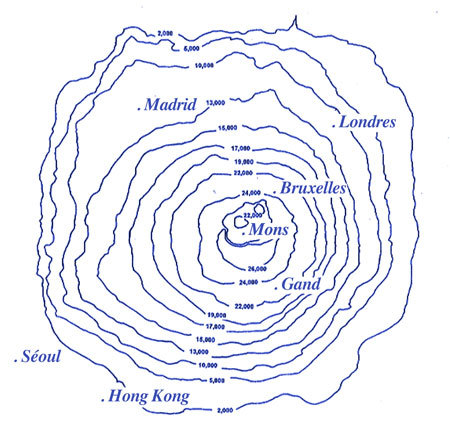
Sound Localities is a project that explores the experience of sound in the city through field recordings and interviews with artists, individuals and organisations in 7 cities in the local, region and international space around Mons, Belgium. From Ghent, Brussels, London, Madrid, Hong Kong and Seoul, the project seeks to produce a wider dialogue in a transcultural space with and through sound as it flows through many complex social and cultural spaces. Individuals and organisations are asked to select artists working with sound in the city to contribute field recordings to express something about their city. These sounds are collected and shared online.
http://soundlocalities.tumblr.com


Soundpocket
Yeung Yang 楊陽is an independent curator, writer and university lecturer. Upon graduating from Yale University with an M.A. in anthropology, she worked as a documentary video director at Radio Television Hong Kong. She graduated in 2004 with a PhD in Intercultural Studies at the Chinese University of Hong Kong. Exhibitions she curated include “in midair, sound works hong kong 2007” (Jun,2007), “Art Responds to 14QK” (Nov 2007), “Nocturne, Alfred Ko solo photography exhibition” (Apr, 2008), and “Around sound art festival” (2009 & 2010). She was also artistic director of “October Contemporary 2009 - Now or Never”. She currently teaches Chinese and Western classics at the Chinese University of Hong Kong. In 2008, she founded soundpocket to promote sound art and its research and education in Hong Kong.
www.soundpocket.org.hk
http://soundlocalities.tumblr.com/post/2828225604/yeung-yang-founder-executive-director


Donnerstag, 15. Mai 2014

Rise and Fall

"Dank dem GPS-Empfänger im Smartphone kennt die App den Aufenthaltsort des Spielers und lässt ihn einen virtuellen Kampf um reale Bars, Restaurants und Sehenswürdigkeiten ausfechten. Als Teil eines Mafia-Clans erobert man den Hauptbahnhof, die Piranha-Bar oder das Bundeshaus. Und man sieht auf dem Display die anderen Spieler, die sich in der Nähe befinden – und kann sich mit ihnen verbünden oder gegen sie antreten."
http://www.tagesanzeiger.ch/digital/computer/Ein-Zuercher-kaempft-gegen-Google-an/story/24534770

The myth of the invisible figure with a microphone


Collateral Damage: Salomé Voegelin
The Wire, May 2014
A new generation of field recordists is challenging the myth of the invisible figure with a microphone in work that celebrates presence rather than absence.


[...]Exciting field recording does not record the field but produces a plurality of fields. lt neither abandons the reality of the recorded, nor does it take it for granted, but works with it, responds to it, understands it as one imprint in the landscape made by the body of the recordist and retraced tentatively by the listener. This listener in turn generates a new imprint between the heard and the recorded, listening to the authenticity of a particular rendition rather than its source, and embracing interpretation as part of the actuality of the real. That is at least what I consider to be exciting. [...]
http://www.thewire.co.uk/in-writing/collateral-damage/collateral-damage_salome-voegelin

Mittwoch, 12. März 2014

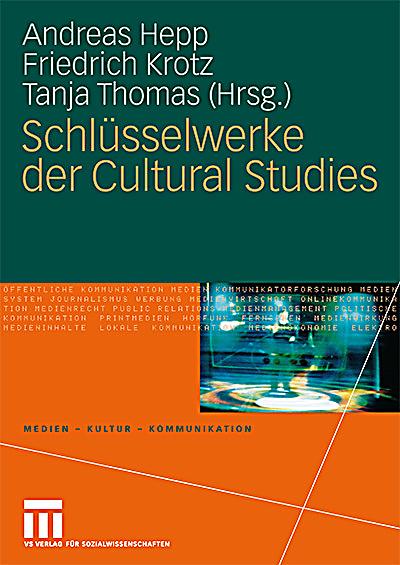
Schlüsselwerke der Cultural Studies

Medien – Kultur – Kommunikation
Kulturen sind heute nicht mehr jenseits von Medien vorstellbar: Ob wir an unsere eigene Kultur oder ,fremde’ Kulturen denken, diese sind umfassend mit Prozessen der Medienkommunikation durchdrungen. Doch welchem Wandel sind Kulturen damit ausgesetzt? In welcher Beziehung stehen verschiedene Medien wie Film, Fernsehen, das Internet oder die Mobilkommunikation zu unterschiedlichen kulturellen Formen? Wie verändert sich Alltag unter dem Einfluss einer zunehmend globalisierten Medienkommunikation? Welche Medienkompetenzen sind notwendig, um sich in Gesellschaften zurecht zu finden, die von Medien durchdrungen sind? Es sind solche auf medialen und kulturellen Wandel und damit verbundene Herausforderungen und Konflikte bezogene Fragen, mit denen sich die Bände der Reihe „Medien – Kultur – Kommunikation“ auseinander setzen wollen. Dieses Themenfeld überschreitet dabei die Grenzen verschiedener sozial- und kulturwissenschaftlicher Disziplinen wie der Kommunikations- und Medienwissenschaft, der Soziologie, der Politikwissenschaft, der Anthropologie und der Sprach- und Literaturwissenschaften. Die verschiedenen Bände der Reihe zielen darauf, ausgehend von unterschiedlichen theoretischen und empirischen Zugängen das komplexe Interdependenzverhältnis von Medien, Kultur und Kommunikation in einer breiten sozialwissenschaftlichen Perspektive zu fassen. Dabei soll die Reihe sowohl aktuelle Forschungen als auch Überblicksdarstellungen in diesem Bereichzugänglich machen.

Schlüsselwerke der Cultural Studies - Andreas Hepp, Friedrich Krotz, Tanja Thomas (Hrsg.)

Freitag, 28. Februar 2014

Ueber Geräusche die Welt deuten - Soundscape-Forschung zwischen Wissenschaft, Kunst und Aktivismus

Wissenschaftler, Soundscape-Komponistinnen und Lärm-Aktivisten kämpfen gegen den Krach von Windfarmen, frönen dem Sound-Tourismus und fragen sich selbstkritisch: Sind wir in der Wissenschaftswelt total im Off? Diskussionen und Streitgespräche an einer Konferenz auf dem finnischen Nationalberg Koli. Eine Sendung von Thomas Burkhalter. Ausgestrahlt am 5.9.2010 im Bayerischen Rundfunk, Zündfunk Generator.
Alle Informationen: norient.com/podcasts/soundscape2010/


Related norient articles:
A journey through noriental Soundscapes
Zwischen Krach und Stille
Die Welt hören – zum Beispiel Lagos
Soundscape-Aktivismus und Komposition

Personal Soundscapes - Auftragswerk von ORF musikprotokoll und ORF Kunstradio

Der Wissensbereich der Website bietet Materialien zur Beschäftigung mit den Begriffen Soundscapes und Fieldrecordings. Eine Reihe von internationalen ExpertInnen und Ö1-JournalistInnen präsentieren in 10 Themenblöcken zahlreiche Audio- und Videofiles, Texte und Fotos rund um die Themen: Alltagsklang wahrnehmen und mit Alltagsklang komponieren.
Overview/Introduction: Personal Soundscapes


John Cage

Mit seinen mehr als 250 Kompositionen, die häufig als Schlüsselwerke der Neuen Musik angesehen werden, gilt er als einer der weltweit einflussreichsten Komponisten des 20. Jahrhunderts.

R. Murray Schafer
Schafer prägte die Begriffe Soundscape sowie Akustische Ökologie und gilt seit den 1960er Jahren als Pionier bei der Erforschung akustischer Umwelten. Sein Ziel: die klingende Umgebung zu verbessern und die Lebensqualität ihrer Bewohner zu steigern.

Sound + Landscape = Soundscape
Soundscape bezeichnet die Gesamtheit aller akustischen Ereignisse an einem bestimmten Ort. Eine Soundscape gibt Aufschluss über deren geographische Gegebenheiten sowie über das dort praktizierte Verhältnis von Mensch, Natur und Technik.

Klangökologie – ein globales Anliegen
Durch das von Murray Schafer ins Leben gerufene World Soundscape Project konnten in den 1970er Jahren weltweit klangökologische Forschungen realisiert werden.

Komponieren mit Soundscapes
Soundscapes ist ein sehr weiter Begriff; erstaunlich vielfältige Künstlerinnen und Künstler nutzen ihn, um ihre jeweiligen Arbeiten zu beschreiben.

Die Welt vertonen
Diskussionen zu Soundscape-Aufnahmen und –Kompositionen in nicht-europäischen Ländern.

ORF Kunstradio – Radiokunst
Seit Dezember 1987 ist das ORF Kunstradio Plattform für Radiokunst aus aller Welt.

Akustik und Stadtplanung
In dem Moment, wo wir es gewöhnt sind, aufmerksam hinzuhören, wird sich auch das Bedürfnis nach einer wohlgestalteten akustischen Umwelt einstellen.

Hörstadt - Akustik, Raum & Gesellschaft
Hörstadt ist ein Labor für Akustik, Raum und Gesellschaft. In Linz angesiedelt und regional, national und international tätig, entwickelt Hörstadt Akustische Raumplanung als neue Disziplin.

Soundscape Mapping
In den letzten 15 Jahren sind eine Reihe von Mapping Projekten entstanden, bei denen Soundcapes aus der ganzen Welt abrufbar sind.

Murray Schafer - Interview by Thomas Burkhalter, 2011

"Wie verändert sich unsere akustische Umgebung – das interessierte Schafer. Und: Wie nimmt unser Ohr Informationen auf. Schafer und seine Forschungsassistenten Barry Truax, Hildegard Westerkamp, Peter Huse, Bruce Davis und Howard Broomfield zogen also mit Aufnahmegeräten und Spezialmikrophonen los, und sie fingen die verschiedenen Lärm- und Geräuschquellen von Vancouver ein. Sie fragten auch die Leute: Wie hört ihr Eure Stadt? Welche Geräusche gefallen Euch – und welche nicht? Es entstand eine Sammlung von Geräuschen aus Vancouver. Und eine Sammlung von Anekdoten darüber, wie es früher geklungen hat in Vancouver. Da war alles dabei: Schiffshörner, das Quietschen der Züge, bis zu Erzählungen von Indianern in den Reservaten." Source: http://norient.com/podcasts/murrayschafer/

Thomas Burkhalter (norient.com) hat Murray Schafer an einer Soundscape Konferenz im Finnischen Koli zum Gespräch getroffen. Ein Portrait. Diese Sendung wurde ausgestrahlt am Mittwoch 23.3.2011 in «Musik unserer Zeit» auf Schweizer Radio DRS2.

Mittwoch, 26. Februar 2014

Auditory Architecture Research Unit (AARU), UDK Berlin

"Auditive Architektur ist eine künstlerisch-wissenschaftliche Disziplin, die sich mit der Erforschung und dem Entwerfen von Klangumwelten befasst. Die Auditory Architecture Research Unit (AARU) wurde gegründet, um den auditiv erlebten Raum für die architektonische Entwurfspraxis zu erschließen und als ein, in diese Praxis integriertes Gestaltungsfeld zu etablieren. Diese Zielsetzung begründet sich in der Tatsache, dass das Auditive unumgänglich konstitutiver Bestandteil erfahrener Architektur ist, jedoch im architektonischen Entwerfen bisher nicht systematisch berücksichtigt wurde.
Die Forschung in der Auditiven Architektur wird als Knotenpunkt zwischen Raum gestaltenden Disziplinen – Architektur, Stadt-, Regional- und Landschaftsplanung –, Sozialwissenschaften – Soziologie, Ethnologie – sowie experimenteller Klanggestaltung und Kognitionswissenschaften mit einem Schwerpunkt auf embodied and situated cognition verstanden. Es werden Strategien, Instrumente und Methoden entwickelt, mit deren Hilfe der auditiv erlebte Raum kognitiv zugänglich wird und als Ausgangspunkt des architektonischen und städtebaulichen Gestaltens genommen werden kann. Im Gegensatz zu den traditionellen akustischen Teilgebieten der Bauphysik ist die Auditive Architektur eine Entwurfsdisziplin, deren Tätigkeit der raum- oder bauakustischen Planung vorausgeht."
http://www.udk-berlin.de/sites/auditive-architektur/content/index_ger.html 

The World Forum for Acoustic Ecology (WFAE)

The World Forum for Acoustic Ecology (WFAE), founded in 1993, is an international association of affiliated organizations and individuals in Europe, North America, Japan, and Australia that share a common concern with the state of the world's soundscapes. WFAE members represent a multi-disciplinary spectrum of individuals engaged in the study of the social, cultural and ecological aspects of the sonic environment.

WFAE'S Mission:
WFAE works in collaboration with its world-wide network of Affiliated Organizations to promote:

Education - in listening to the soundscape, sharpening aural awareness and deepening listeners' understanding of environmental sounds and their meanings
Research and Study - of the social, cultural, scientific and ecological aspects of the sonic environment
Publishing and Distributing of information and research on Acoustic Ecology.
Protecting and Preserving existing natural soundscapes and times and places of quiet.
Designing and Creating healthy and acoustically balanced sonic environments.

http://wfae.proscenia.net/

Auditive Langzeitbeobachtung Schlieren

Auditive Langzeitbeobachtung Schlieren ist ein von 2007 bis 2020 dauerndes Forschungsprojekt, das parallel zur Fotografischen Langzeitbeobachtung Schlieren der Zürcher Hochschule der Künste durchgeführt wird und das sich der dynamischen Entstehung sowie der Struktur von Klangumwelten im öffentlichen Raum der Schweizer Stadt Schlieren widmet.
Der Anlass für dieses Projekt ist die gegenwärtige Umsetzung eines umfassenden Stadtentwicklungskonzeptes der Stadt Schlieren zur Aufwertung des urbanen Raums.
Ziel der Auditiven Langzeitbeobachtung Schlieren ist die Entwicklung präziser Methoden für die Erfassung der Veränderung der städtischen Klangumwelt, mittels derer die Auswirkungen der geplanten Entwicklungsmaßnahmen auf den auditiv erlebten Raum untersucht werden können.

Projektteam: Alex Arteaga und Thomas Kusitzky
http://wahrnehmung-agglomeration.ch

Sound Translations

XL Teaser for the upcoming film by Thomas Burkhalter (norient.com) and Peter Guyer (Recycled TV)
The FOKN Bois raise money for the United States of America in the streets of Ghana. Their provocative motto: «Africa is on the way up, and the US are on the way down.» This XL- teaser «Ghana is the Future» shows how these two rappers compete with, against and within various growing markets in Ghana: new churches like the «Alive Chapel International», and mobile phone companies like «Glo Mobile». The rap duo comments on these markets with humour and parody and reaches international and local audiences. - This XL-Teaser is part of the upcoming film and multimedia project «Sound Translations» by Peter Guyer (Recycled TV AG) and Thomas Burkhalter (Norient).

http://norient.com/video/teaser-africa-is-the-future/
http://norient.com/events/sound-translations/

Peter Guyer (Recycled TV AG)
Peter Guyer (Recycled TV AG

Book Review IN THE FIELD: THE ART OF FIELD RECORDING, Cathy Lane & Angus Carlyle

Book Review by Marcel Cobussen

 "For several reasons I have a rather ambivalent relation towards field recordings. This ambivalence is not necessarily annoying, disturbing, or irritating; it is simply that I am often puzzled, confused, and full of questions after having listened to field recordings. One of these questions that regularly arises is: To what have I actually listened? Let’s say that on one side of the spectrum I could consider those recordings as something like sonic documentaries, introducing me to unknown, lost, or past soundscapes; on the other side, I do not attempt to situate or identify the sounds, but perceive the recordings with a more or less purely aesthetic attitude. Or, to reformulate this, the former raises questions about the representational value, including ideas about “sonic journalism” or “docu-music” as Peter Cusack calls it, whereas the latter is inviting me, first of all, to attentive listening, to perceiving, without too much reflecting, the richness of the sounds, their individual layers as well as the complexity of their potential relations and combinations, close to Pierre Schaeffer’s acousmatic listening. Choosing between, let’s put it boldly, the rational and the aesthetic or between “truth” and “beauty,” is often codetermined by the additional information accompanying the recordings: [...]